The Best Cookbooks for Beginners: 7 Books That Actually Teach You to Cook
Chef-reviewedChef John Guerrero10 min
In this article10 sections
The short answer: if you are buying your first cookbook, start with Salt, Fat, Acid, Heat to learn how cooking works, and add The Food Lab when you want to understand why a technique fails. If you would rather follow instructions than theory, How to Cook Everything: The Basics is the most forgiving book on this list.
Summary: these seven books teach cooking rather than just collect recipes. They cover the two halves of learning: the four elements that govern flavour (salt, fat, acid, heat), and the tested technique that makes a dish repeatable. Everything here has been cooked from in a working kitchen, not skimmed on a shelf.
Who this is for: someone who can boil water and wants to cook properly — the first cookbook, or the second one after a gift book that never clicked.
Cooking, like any trade, has a small number of skills that unlock everything else: how to season, how to control heat, how to build flavour, how to know when something is done. A good beginner cookbook teaches those. A bad one gives you 300 recipes and no reason to trust any of them.
I cook professionally and write about food for a living. These are the books I hand to people who ask me what to buy first — and the reasons why they beat the alternatives.
The best cookbooks for beginners at a glance
| Book | Best for | Author | What makes it work |
|---|---|---|---|
| Salt, Fat, Acid, Heat | Learning to cook without recipes | Samin Nosrat | Teaches four elements instead of dishes |
| The Food Lab | Understanding why cooking works | J. Kenji López-Alt | Every technique tested and explained |
| How to Cook Everything: The Basics | Absolute beginners | Mark Bittman | Short recipes, no assumptions, hard to get wrong |
| Ratio | Cooking from memory | Michael Ruhlman | Gives the proportions behind dishes |
| Essentials of Classic Italian Cooking | Learning one cuisine properly | Marcella Hazan | One cuisine, built from the foundations up |
| Mastering the Art of French Cooking | Growing into technique | Julia Child | The reference to work up to, not start with |
| Plenty | Vegetables and everyday sides | Yotam Ottolenghi | Makes vegetables the main event |
1. Salt, Fat, Acid, Heat, by Samin Nosrat — the best first cookbook
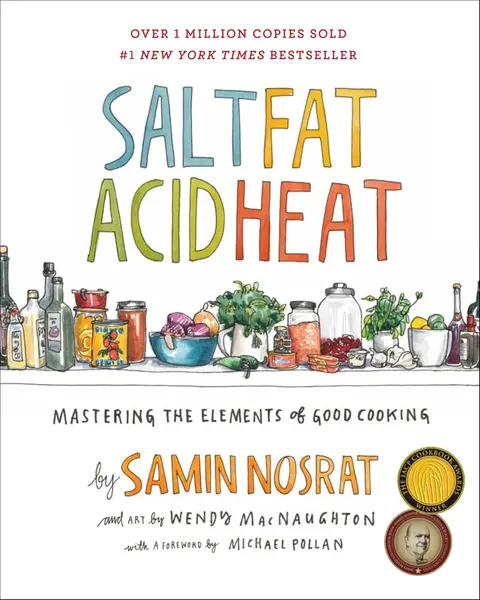
Salt, Fat, Acid, Heat
Samin Nosrat
The book that teaches you to cook without a recipe: four elements explain almost every decision you make at the stove, with illustrations by Wendy MacNaughton that make the ideas stick.
Prices and availability on Amazon US
Most cookbooks hand you a fish. This one teaches you to hold the rod, and it is remarkable how quickly that pays off. The idea is disarmingly simple: good cooking is governed by four things — salt, fat, acid and heat — and if you understand what each of them does, you stop needing to follow recipes exactly.
That matters more for a beginner than for anyone else, because beginners are the people most likely to follow a recipe off a cliff. Recipe says 20 minutes; your oven runs cool; you end up with dry chicken and no idea why. Once you understand that heat is a tool you control rather than a number someone else chose, you start tasting, adjusting and trusting yourself.
Read the first four sections before you cook anything. Then cook one thing from each of them.
2. The Food Lab, by J. Kenji López-Alt — the best second book
The Food Lab
J. Kenji López-Alt
A doorstop of a book that turns home cooking into an experiment: every technique is explained, compared and tested, from why you should salt pasta water to what makes a burger juicy.
Prices and availability on Amazon US
If Salt, Fat, Acid, Heat gives you the principles, The Food Lab gives you the evidence. Kenji López-Alt’s approach is straightforward: if cooks disagree about something, cook it both ways and see. The result is the most useful troubleshooting reference in a home kitchen.
It is not a book you read front to back — it is a book you open when something went wrong. Browned butter that tastes bitter? A stew that came out thin? There is a section that explains the mechanism, and then a version of the recipe that works.
We review this one in detail in our full Food Lab review if you want to know whether it fits your level.
3. How to Cook Everything: The Basics, by Mark Bittman — the easiest to start with
How to Cook Everything: The Basics
Mark Bittman
Short, plain recipes with almost no assumptions: sautés, soups, roast chicken, simple cakes. The most forgiving place to start if you would rather cook tonight than read theory first.
Prices and availability on Amazon US
If you have never cooked anything and want dinner tonight, this is the book to reach for. Recipes are short, ingredients are ordinary, and it explains the moves that most cookbooks assume you already know — how to chop an onion, how to tell when a pan is hot enough, how to roast a chicken.
The trade-off is depth. This is not a book that explains the science, and it will not turn you into a confident improviser on its own. Use it to build the habit of cooking, then move to The Food Lab or Ratio to build judgement. Pairing it with the beginner path is the sequence I recommend most often.
4. Ratio, by Michael Ruhlman — best for cooking without a recipe
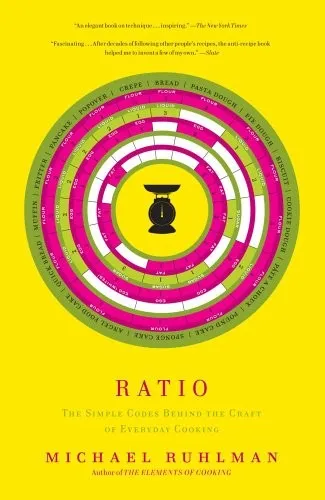
Ratio
Michael Ruhlman
The proportions behind everyday cooking — dough, batter, vinaigrette, custard — so you can make them from memory instead of hunting for a recipe.
Prices and availability on Amazon US
Every dish you make has proportions underneath it. A vinaigrette is three parts oil to one part acid; bread dough is roughly five parts flour to three parts water; a custard has a ratio of egg to liquid. Once you know those numbers, a recipe becomes a reminder instead of an instruction.
Beginners sometimes feel this book is too abstract. The honest answer: read it after you have cooked ten or fifteen dishes. At that point, it stops being theory and starts saving you real time.
5. Essentials of Classic Italian Cooking, by Marcella Hazan — best single-cuisine book
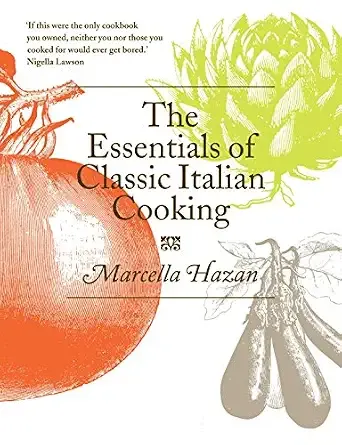
Essentials of Classic Italian Cooking
Marcella Hazan
One cuisine, taught from the foundations: how Italians cook vegetables, pasta, sauces and roasts, with the technique explained rather than assumed.
Prices and availability on Amazon US
Learning one cuisine properly teaches you more than skimming six. Italy is a good choice because its cooking is built on technique that transfers everywhere: cooking onions slowly, finishing pasta in its sauce, treating good ingredients with restraint.
Marcella Hazan is famously opinionated, and that is part of the value. When a book tells you exactly why a shortcut is wrong, you learn to taste the difference for yourself. The tomato-butter-onion sauce alone justifies the shelf space, and it is about as beginner-friendly as cooking gets.
6. Mastering the Art of French Cooking, by Julia Child — the book to grow into
Mastering the Art of French Cooking, Vol. 1
Julia Child
The classic that taught a generation to cook French food at home. Not the easiest starting point, but the clearest explanation of why classic technique is built the way it is.
Prices and availability on Amazon US
I am deliberately putting this sixth and not first. It is a magnificent book — methodical, precise, and honest about failure points — but it was written for readers who already had some kitchen confidence, and its recipes are long by modern standards.
Buy it when you want a project. Work through the omelette, the roast chicken and one sauce, and you will understand more about building flavour than from any trendy book. If you are not there yet, start with the path and come back to Julia Child in six months.
7. Plenty, by Yotam Ottolenghi — best for vegetables
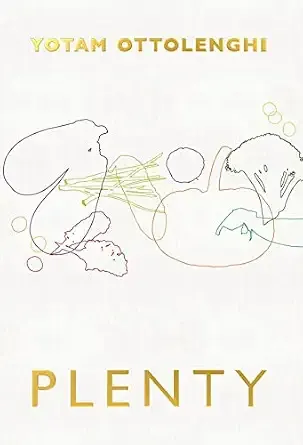
Plenty
Yotam Ottolenghi
Vegetable cooking treated as the main event: concentrated flavour, generous seasoning and techniques that make a plate of greens worth the plate.
Prices and availability on Amazon US
Most beginners undercook vegetables, underseason them and serve them as a duty. Ottolenghi’s first vegetable book is the cure: it treats them as the dish, and it teaches the habit of layering flavour with oil, salt, acid, herbs and heat.
Some recipes call for ingredients you will not have on day one — that is fine. Start with the ones that do not, and notice how much you learn about seasoning from cooking vegetables instead of meat.
How we chose these books
Three filters, applied in order:
- Does it teach, or does it only instruct? A book that explains the mechanism survives the second time you cook from it. A book that only lists steps gets replaced.
- Could a beginner actually execute this? Ingredients you can buy in a normal supermarket, equipment you already own, and instructions that tell you what “done” looks like.
- Does it reward years of use? The test is not how good the book is in month one, but whether you still open it in year three.
Price and page count played no part, and we do not currently publish prices: a cookbook’s price changes weekly while its value does not. Check the current price at your storefront above.
How to use a cookbook when you are just starting
- Cook three recipes twice each, not ten recipes once. Repetition is what turns a recipe into a skill. The second attempt is where you learn.
- Read the whole recipe before you shop. Missing an overnight rest or a two-hour simmer is the most common beginner failure, and it is always in the last line.
- Write in the book. Notes in the margin — “needed more salt”, “oven ran hot” — are what make a cookbook yours.
- Do not buy five books. One teaching book plus one recipe book covers a first year of cooking comfortably.
Frequently asked questions
What is the best cookbook for a complete beginner?
How to Cook Everything: The Basics by Mark Bittman, if you want to cook tonight with minimal reading. Salt, Fat, Acid, Heat by Samin Nosrat, if you want to understand what you are doing and are willing to read first. Either is a strong first purchase; choose by whether you learn better by doing or by understanding.
Do I need more than one beginner cookbook?
No, not to start. One book that teaches principles and one that supplies everyday recipes is enough for a first year. Buying five cookbooks at once is a common way to end up cooking from none of them.
Are cookbooks still worth it when recipes are free online?
Yes, for two reasons. A good cookbook is edited and tested as a whole, so the recipes are consistent and the technique is explained once rather than repeated badly on twenty websites. It also does not open with a forty-second video, which matters when you are standing at a hot stove.
What is the difference between The Food Lab and Salt, Fat, Acid, Heat?
Salt, Fat, Acid, Heat is a short, conceptual book about the four elements of flavour: read it to learn how to think. The Food Lab is a long, evidence-based reference about technique: open it when you need to know why something worked or failed. They are complementary, and buying both is the single best investment a new cook can make.
Should a beginner start with a baking book or a cooking book?
Start with cooking. Savoury cooking forgives small mistakes — you taste and adjust as you go — while baking is a chemical reaction that punishes a wrong quantity or an uncalibrated oven. Master heat, seasoning and timing first; baking becomes far easier afterwards.
How long does it take to learn to cook from a cookbook?
Give it three months of cooking two or three times a week. You will not be fast or consistent by then, but you will stop needing the book open for basic dishes, which is the real milestone. See where to start for a structured order to work through.
Do I need expensive equipment to follow these books?
No. A sharp knife, a large pan, a pot, a wooden spoon, a tray and a digital thermometer cover almost everything in the seven books above. Buy the books first; equipment gets replaced as you learn what you actually use.
What next?
Find your next cookbook
Browse our full guide to the best cookbooks, updated for 2026, or ask for a personal recommendation.