The Food Lab review: is Kenji López-Alt's book worth it for a home cook?
Chef-reviewedChef John Guerrero7 min
In this article6 sections
The short answer: The Food Lab is the best troubleshooting reference a home kitchen can own, and a poor choice as somebody’s first cookbook. If you already cook and want to know why things work — or why last night’s dinner did not — buy it. If you have never cooked, read Salt, Fat, Acid, Heat first.
Summary: The Food Lab: Better Home Cooking Through Science by J. Kenji López-Alt applies the test-everything method of food science writing to ordinary home cooking. Instead of asserting that you should do something, it cooks the alternatives side by side and shows you the difference. The result is a reference book that answers questions rather than a recipe collection you cook through in order.
Who it is for: the cook who is already comfortable at the stove and wants to stop guessing. Professional cooks will find it useful for the same reason: it quantifies things that kitchens usually pass on as folklore.
What The Food Lab actually is
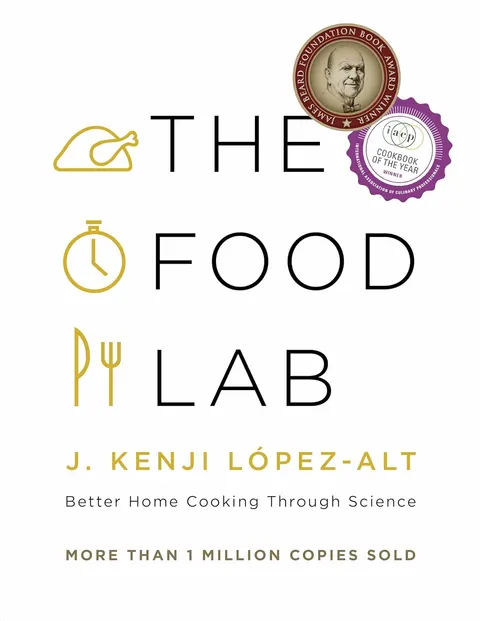
The Food Lab
J. Kenji López-Alt
Better home cooking through science: the definitive book on the why behind every technique, from salting pasta water to the temperature that makes a burger juicy.
Prices and availability on Amazon US
It is a single very thick volume, and it is not organised the way you expect a cookbook to be. There is a large recipe section, but the recipes sit inside chapters about mechanisms: how heat moves, what salt does to protein, why a sear does not “seal in” juices, what gluten is doing in your dough.
That structure is the whole point. Kenji López-Alt spent years running the test kitchen at Serious Eats, and the method carries over intact: take a claim that cooks repeat, design an experiment that could falsify it, and report what happened. Sometimes the folklore survives. Often it does not.
The topics are deliberately ordinary. Roast chicken. Burgers. Boiled eggs. Pancakes. Macaroni and cheese. Green vegetables that stay green. This is not a book about restaurant technique dressed up for home cooks; it is a book about the food people actually cook on a Tuesday.
What you will learn from it
Three things, in practice:
Why a technique works. Once you know that a steak browns through the Maillard reaction and that the reaction needs a dry surface, you stop crowding the pan — not because a recipe told you, but because you understand the constraint. That knowledge transfers to food the book never mentions.
How to fix a failure. The most valuable chapters are the ones where something has gone wrong. Thin sauce, tough braise, gummy rice, split custard. Each gets a mechanism and a correction, which is worth more than a recipe you only follow once.
What is worth ignoring. A good part of kitchen folklore is either wrong or irrelevant at home. Knowing which advice you can drop makes cooking faster and less anxious.
Pros and cons
Pros
- The most useful troubleshooting reference in home cooking: mechanisms, not just instructions.
- Kitchen-tested rather than asserted, with the tests explained.
- Covers the dishes beginners actually cook, not aspirational restaurant food.
- Excellent on the unglamorous fundamentals: heat, salt, timing, doneness.
- Holds up over years — you open it when a specific problem appears.
Cons
- It is a poor first cookbook. Recipes are long, and the reading load is real.
- Heavy and physically awkward to keep open on a counter; a stand or a second copy helps.
- Some topics are covered so thoroughly that the book becomes a reference rather than a pleasure read.
- A few recipes assume equipment — a thermometer especially — that beginners may not own yet. Buy the thermometer; the book is far better with one.
Customer opinion, honestly framed
If you look at reader reviews you will find the same three reactions repeated: cooks who say it changed how they cook, cooks who found it too long to read cover to cover, and cooks who expected a recipe collection and got a science book instead.
All three are accurate. The disagreement is about expectation, not quality. If you want a book you cook through in order, this is not it. If you want the book you reach for when something goes wrong, it is difficult to beat.
The Food Lab versus Salt, Fat, Acid, Heat
This is the comparison worth making, because most people considering one should consider the other.
| Criterion | The Food Lab | Salt, Fat, Acid, Heat |
|---|---|---|
| Approach | Experimental: tests and explains techniques | Conceptual: four elements of flavour |
| Length | Very long, reference sized | Short, readable in a weekend |
| Best moment | Something went wrong, or you want depth | You are learning to think about cooking |
| Recipes | A long tested section, explained in depth | Fewer, chosen to illustrate principles |
| Best for | Cooks with some confidence | Complete beginners |
The honest recommendation for most people is both, in a specific order: Salt, Fat, Acid, Heat to learn the principles, The Food Lab as the reference you keep. We compare the seven strongest beginner options in the best cookbooks for beginners.
Verdict
Buy it if you already cook and want to stop guessing. It is the single best troubleshooting reference in home cooking and it rewards years of use.
Skip it for now if you have never cooked a meal from scratch. Start with a book that teaches principles and get this one when you have a specific question to answer — which, if you keep cooking, will happen within a few months. If you want the structured order to follow, that is exactly what our beginner path lays out.
Frequently asked questions
Is The Food Lab good for beginners?
Not as a first book. It is written for cooks who already have basic confidence and want to understand technique more deeply. Complete beginners are better served by Salt, Fat, Acid, Heat or How to Cook Everything: The Basics, then this one.
How many recipes does The Food Lab have?
It is not a book you cook through by count. The recipes are spread across chapters organised by technique rather than by dish, so it works as a reference you open when you need a specific answer or a tested version of a familiar dish.
Is The Food Lab worth the money?
If you cook several times a week, yes: it replaces a shelf of troubleshooting searches with a single tested source, and it stays useful for years. If you cook rarely or want short recipes, a simpler beginner book gives you more per dollar.
Do I need a thermometer to use The Food Lab?
It is not strictly required, but the book is significantly better with one. Much of the value is in precise doneness — meat, custard, bread — and a cheap digital probe thermometer turns those explanations into results you can reproduce.
What is the difference between The Food Lab and The Wok?
The Food Lab is Kenji López-Alt’s general reference on western home cooking across all techniques. The Wok is a later, narrower book dedicated to wok cooking and stir-frying. If you cook mostly western food, start here.
Does The Food Lab cover baking and pastry?
Only partly. Bread, pancakes, batters and some pastry appear where a technique needs explaining, but it is not a baking book. For that you want a dedicated baking reference.
What next?
Find your next cookbook
Browse our full guide to the best cookbooks, updated for 2026, or ask for a personal recommendation.