Learn to cook: where to start (a 5-step reading path for beginners)
Chef-reviewedChef John Guerrero7 min
In this article8 sections
The short answer: start with heat, salt and repetition. Cook simple dishes three times each rather than ten dishes once, learn the four elements that govern flavour, then decide which cuisine you want to go deep on. The order matters more than the talent, and it takes months rather than weeks.
Summary: this is the reading path I give to people who want to learn to cook properly from zero. It is five steps in a deliberate order, one cookbook per step, with a diagnosis first so you start at the right place instead of at the beginning of somebody else’s journey.
Who it is for: anyone who can boil water and follow a packet but freezes when a recipe says “season to taste” — students leaving home, adults who never learned, and anyone whose cooking stalled at “edible”.
Cooking is a trade with a short list of core skills. Almost everything else is variation. The problem for beginners is that cookbooks are not organised to teach those skills in order — they are organised by dish, which is how a cook who already knows the fundamentals wants to use them.
First, diagnose your level
Answer three questions honestly:
- Can you cook a simple savoury dish without following a recipe line by line? (An omelette, a pasta sauce, a roast chicken, a stir-fry.)
- When something goes wrong, do you know why? (Dry chicken, bland stew, soggy vegetables, broken sauce.)
- Can you season by tasting rather than by measuring? (Adjust salt, acid and fat until the dish tastes right.)
- Zero yeses → start at Step 1 and do not skip it.
- One or two yeses → start at Step 2. You have technique; you are missing principles.
- Three yeses → skip to Step 4. You need proportions and a specialism, not fundamentals.
Step 1. Build the habit: cook from short recipes
Objectives
- Cook 12 to 15 different simple dishes, two or three times each.
- Learn how your own oven, hob and pans actually behave.
- Get comfortable improvising around a short recipe.
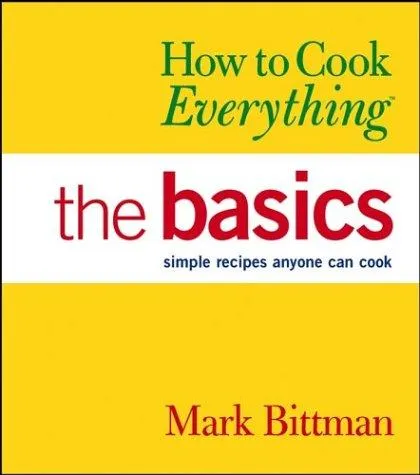
How to Cook Everything: The Basics
Mark Bittman
Short, plain recipes with almost no assumptions — the most forgiving book to start with. This step is about cooking often, not reading deeply.
Prices and availability on Amazon US
The goal here is not knowledge, it is volume. You need the muscle memory of chopping, tasting and adjusting before theory becomes useful. Pick recipes with five ingredients and thirty minutes.
Next step → once you can cook three dishes without reading every line, move on.
Step 2. Learn the four elements of flavour
Objectives
- Understand what salt, fat, acid and heat each do to food.
- Learn to correct a dish instead of starting over.
- Stop needing exact measurements for seasoning.
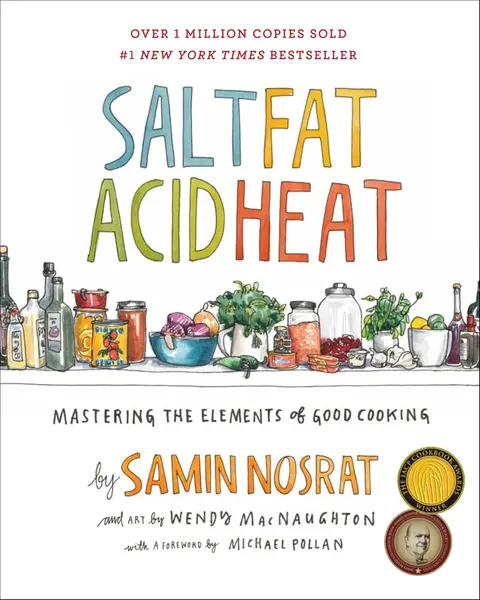
Salt, Fat, Acid, Heat
Samin Nosrat
The book that teaches you to cook without a recipe: four elements explain nearly every decision you make at the stove.
Prices and availability on Amazon US
This is the step that changes how you think. When a dish tastes flat, it is almost always missing salt or acid, and knowing that saves you from adding ingredients that cannot rescue it. Follow this up with the best cookbooks for beginners if you want to compare alternatives before buying.
Next step → cook one dish from each of the four sections before moving on.
Step 3. Learn why techniques work
Objectives
- Understand the mechanism behind the techniques you have been copying.
- Diagnose and repair common failures.
- Learn which kitchen folklore you can safely ignore.
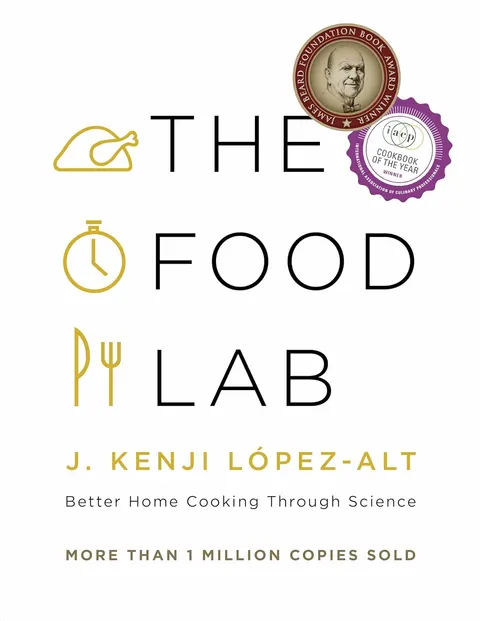
The Food Lab
J. Kenji López-Alt
The troubleshooting reference: every technique explained, tested and compared, from why you salt pasta water to what makes a burger juicy.
Prices and availability on Amazon US
Step 2 gives you principles, Step 3 gives you evidence. From here on, questions get answered rather than remembered. There is a fuller verdict in our Food Lab review if you want the trade-offs before buying.
Next step → use this one as a reference, not as a book to read in order.
Step 4. Learn proportions and drop the recipe
Objectives
- Memorise the proportions behind doughs, batters, custards and dressings.
- Invent a dish without a recipe and have it work.
- Learn to write down what you did, so you can repeat it.
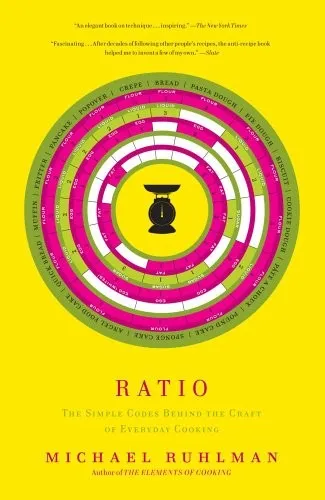
Ratio
Michael Ruhlman
The proportions behind everyday cooking, so you can make a vinaigrette, a bread dough or a custard from memory.
Prices and availability on Amazon US
At this point you are cooking, not following. Ratios turn recipes into templates, which is the difference between someone who cooks and a person with a cookbook. If this step feels abstract, it means Step 1 needs a few more weeks.
Next step → pick one cuisine you actually eat and go deep.
Step 5. Choose one cuisine and go deep
Objectives
- Learn a cuisine’s foundations rather than isolated recipes.
- Recognise the same techniques appearing under different names.
- Reach the point where you can cook dinner confidently without a book open.
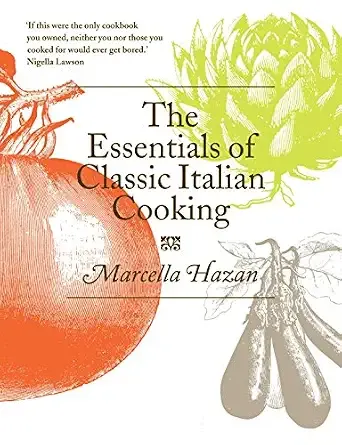
Essentials of Classic Italian Cooking
Marcella Hazan
One cuisine taught from the foundations: vegetables, pasta, sauces and roasts, with technique explained rather than assumed.
Prices and availability on Amazon US
Italy is a good first specialism because its technique transfers everywhere: slow-cooked onions, pasta finished in its sauce, restraint with good ingredients. When you want a harder challenge, Mastering the Art of French Cooking by Julia Child is the classic to grow into.
Order matters more than talent
The most common reason people stall is not a lack of ability, it is a lack of order. They start with a beautiful French cookbook, fail at a four-hour recipe in week two, and conclude they cannot cook — when the real problem was starting at Step 5.
Each step in this path exists to make the next one possible. Step 1 gives you hours at the stove. Step 2 gives you judgement. Step 3 gives you explanations. Step 4 gives you independence. Step 5 gives you depth.
What you do not need
A short list, because beginners overspend:
- A knife set. One sharp chef’s knife and one small paring knife will out-cook a block of twelve.
- Every gadget on the shelf. A mandoline, an air fryer and a sous-vide circulator solve problems you do not have yet.
- Five cookbooks at once. One teaching book and one recipe book cover the first year. Buying more is a way of postponing cooking.
- Expensive ingredients while you are learning. Practice on chicken thighs and onions; save the scallops until your heat control is consistent.
- A course before a habit. Courses help once you cook regularly; they cannot substitute for hours at the stove.
Frequently asked questions
How long does it take to learn to cook?
Expect three months of cooking two or three times a week to handle basic dishes without a recipe, and about a year to be genuinely comfortable. Anyone promising a weekend is selling something. Cooking follows the same curve as any physical skill: early progress is fast, then competence is built by repetition.
Should I learn from cookbooks or from videos?
Both, for different things. Videos are better for physical movements — knife grip, folding, kneading. Cookbooks are better for understanding: they can explain a mechanism, a proportion and a correction in a way a video rarely does. In this path, videos accelerate Step 1 and books carry Steps 2 to 5.
Do I need to buy all five books?
No. Steps 1 and 2 cover the first year for most people. Steps 3 to 5 are additions you make when the questions actually appear — and by then you will know exactly what you want.
I cannot cook at all. Where do I start?
Step 1, and only Step 1. Cook something simple — an omelette, a soup, a tray of roasted vegetables — three times this week. Confidence comes from repetition, not from reading. Come back for the theory once the stove stopped feeling unfamiliar.
Is it better to learn one cuisine or many?
One, first. Learning a single cuisine properly teaches you a coherent set of techniques that then transfer to everything else; skimming six cuisines leaves you with six sets of half-learned recipes. Pick the food you already eat and enjoy.
Do I need to learn baking too?
Eventually, and later than most people think. Baking is less forgiving because it depends on precise chemistry rather than tasting and adjusting. Get comfortable with savoury cooking first — heat, salt and timing — and baking becomes much easier to learn.
What next?
Find your next cookbook
Browse our full guide to the best cookbooks, updated for 2026, or ask for a personal recommendation.